Why Your Business Can’t Ignore Telegram (and MiniApps)
If you’re building an online business in 2025-whether in DeFi, crypto, fintech wallets, iGaming, SaaS, or global e-commerce-there’s one platform you can’t afford to overlook anymore: Telegram.
Telegram is a fast, secure, and globally adopted messaging app with more than 1 billion active users worldwide. While adoption in the U.S. is still catching up compared to WhatsApp or iMessage, in Europe, Asia, Latin America, and the Middle East, Telegram is already the default platform for communities, finance, and entertainment. That means if your product has international users, you’re leaving serious opportunity on the table by not being present there.
And here’s the real shift: Telegram is no longer just about group chats and channels. The platform has launched a new format called MiniApps, and it’s already changing how brands reach and convert customers.
👉 If you’re new to Telegram itself, we recommend starting with our article “What Is Telegram and Why Businesses Use It” for the basics. But in this piece, we’ll dive straight into the real opportunity: Telegram MiniApps for business.
Need a Telegram MiniApp?
We build everything from quick out-of-the-box solutions (ready in 2+ weeks) to large-scale projects like TripleA News.
What Makes Telegram MiniApps a Game Changer?
MiniApps are lightweight applications that open instantly inside Telegram. Unlike traditional mobile apps, they don’t require an App Store or Google Play download. A user taps a link in a channel, a QR code in a store, or a button in an ad-and the MiniApp launches immediately.
For businesses, the value is simple but powerful: shorter customer journeys, higher conversion, and lower cost of ownership.
- Higher conversion. In a traditional funnel, you lose up to 50% of potential users just at the installation step. MiniApps skip that barrier entirely. Your customer sees → taps → acts.
- Faster time-to-market. Instead of waiting months for approvals, reviews, and updates, a MiniApp can be live in a couple of weeks. That means you can test hypotheses, change mechanics, and react to market shifts much faster than with a native app.
- Lower cost. Supporting a MiniApp is significantly cheaper than maintaining iOS and Android apps separately. No duplicate releases, no store restrictions-updates are automatic, and every user sees the latest version instantly.
MiniApps are especially critical in high-velocity verticals like food delivery, ticket sales, event promotions, flash discounts, or online services-anywhere speed and simplicity make or break the sale.
For founders and entrepreneurs, the message is clear: Telegram MiniApps aren’t just another feature. They’re a new way to do business inside one of the fastest-growing global platforms.
Why MiniApps Outperform Traditional Mobile Apps for Business
The biggest advantage of Telegram MiniApps is that they remove the barriers to entry. With a native app, you’re stuck in the same old cycle: submit to the App Store or Google Play, wait for approval, cross your fingers you won’t get flagged, and then pray every update passes review. With a MiniApp, none of that matters. You launch directly-via a link in a Telegram channel, a QR code on your packaging, or even a button in an ad. Instant access.
For the user, it’s frictionless. One Telegram account unlocks every MiniApp. It doesn’t matter whether they’re on iPhone, Android, tablet, or desktop-your product works the same everywhere. That eliminates the constant “will this work on my device?” hesitation that kills conversions.
Another underrated point: storage fatigue. Users are tired of cluttering their phones with dozens of apps that take up memory, need endless updates, and eventually get deleted. A MiniApp doesn’t live on their device-it lives in the cloud. It opens in seconds, always updated, and doesn’t compete with Netflix or Spotify for storage space. That’s not just convenient—it’s a retention advantage.
For your business, this translates into:
📌 Wider reach – you don’t lose half your audience during the download/installation step.
📌 Reliability – one version runs consistently across all devices.
📌 Speed to market – you can push changes instantly, without waiting weeks for store approvals.
📌 Lower overhead – no costly release cycles or dependency on Apple/Google rules.
Most importantly, MiniApps give you the ability to deliver results right now. Instead of waiting months for a development cycle to play out, you can test, iterate, and capture revenue in days.
This is where the shift happens: businesses stop adapting to the slow pace of app stores and start using MiniApps to move faster, sell more, and grow smarter.
Architecture & Integrations: How Telegram MiniApps Fit Into Your Business
Telegram MiniApps aren’t just “games in a chat.” For businesses, they can become a core part of your infrastructure—plugging directly into the tools you already use to manage customers, sales, and content.
A MiniApp can connect to your CRM (Customer Relationship Management system). That means every person who opens your MiniApp can automatically be added to your database. You’ll see their full journey-from first click to final purchase-without extra manual work.
They can also integrate with CDPs (Customer Data Platforms), which track user behavior across channels. With that data, you can build smart audience segments: who buys, who browses, who returns again and again. This level of visibility is usually expensive to achieve with traditional apps-but it comes built into the MiniApp ecosystem.
Your CMS (Content Management System) can also be linked. That allows products, blog posts, promotions, or services from your website to appear directly inside your Telegram MiniApp. You update once, and it’s visible everywhere-site and MiniApp included.
Payments are seamless too. MiniApps already support global providers like Stripe, PayPal, Apple Pay, and even crypto wallets on TON. Customers don’t have to leave Telegram or enter new payment details-checkout happens instantly inside the chat.
Security and convenience come together with SSO (Single Sign-On). Users don’t need to create new accounts or remember new passwords. Their existing Telegram profile is enough, giving you lower friction and higher conversions.
And don’t underestimate the power of notifications. With MiniApps, you can send reminders, push promotions, or trigger automated messages directly into a user’s Telegram chat. That’s a direct, high-open-rate channel-something email and push notifications can’t compete with anymore.
Behind the scenes, integrations are handled with APIs, webhooks, and pre-built connectors. You don’t need to be a developer to understand the point: your Telegram MiniApp isn’t a “standalone toy”-it can function as a fully integrated part of your business ecosystem.
Need a Telegram MiniApp?
We build everything from quick out-of-the-box solutions (ready in 2+ weeks) to large-scale projects like TripleA News.
Gamification: Turning Audiences Into Engaged Customers
Let’s be honest-customers rarely come back to a brand “just because.” But add a layer of gamification, and suddenly everyday actions turn into a compelling habit. That’s one of the strongest features of Telegram MiniApps for business.
The simplest approach is daily streaks. A user checks into your MiniApp every day, gets a small bonus, and slowly builds the habit of returning. What started as curiosity turns into routine.
Quests and challenges make it even more powerful. Step 1: open a product page. Step 2: share a referral link. Step 3: complete a purchase. Each action feels like a mission, with rewards guiding the customer toward the exact path you want them to take.
Adding levels and status tiers (Silver, Gold, Platinum) gives people an extra push. Customers love to track progress, unlock privileges, and compare their standing with others. It transforms loyalty into motivation.
Leaderboards and rankings take this social. They’re especially effective in niches like fitness, education, or online courses. When people see their name climbing the board-or risk being overtaken by friends-they’re driven to come back again and again.
Even lighter formats like spin-the-wheel, scratch cards, or collectible cards can boost engagement. They introduce a fun element of surprise without requiring heavy development.
But here’s the rule: gamification must amplify your brand, not overshadow it. A Telegram MiniApp isn’t supposed to feel like a casino. It’s a business tool that uses game mechanics to keep customers engaged, loyal, and gently nudged toward your desired actions-whether that’s a purchase, a registration, or a subscription.
Loyalty Programs Inside MiniApps
Telegram MiniApps aren’t just about driving one-time sales—they’re about building long-term relationships with your customers. And the easiest way to keep people coming back is with a loyalty program that lives directly inside your MiniApp.
Think of it as a digital rewards card that never gets lost. Every purchase, subscription, or referral can automatically add points to a user’s balance. Customers can then redeem those points for discounts, gifts, or exclusive access. Because everything happens inside Telegram, users instantly see their progress and are motivated to return.
Tiered programs work even better. Imagine turning regular shoppers into “Silver,” “Gold,” or “Platinum” clients. As their engagement grows, so do their benefits-priority service, early access to drops, or special VIP promotions. A loyalty program inside a MiniApp makes these upgrades seamless.
Coupons and gift cards are also easy to distribute. A customer receives a promo code right in their Telegram chat and can use it online or in-store. Paired with QR scanners at checkout, you can instantly connect offline purchases with online rewards.
And don’t forget fraud protection. MiniApps can be configured to prevent duplicate claims or fake sign-ups, keeping your loyalty program sustainable.
For businesses, this isn’t just a “nice extra.” A MiniApp loyalty program directly raises customer lifetime value (LTV). The easier and more rewarding it is for people to engage with your brand, the more often they’ll come back.
Lead Generation and Higher Conversions
At the end of the day, every business wants the same thing: turn attention into real customers. Telegram MiniApps are perfect for lead generation because they strip away friction and make the process simple.
Instead of long websites or clunky landing pages, you can create quiz-based funnels inside your MiniApp. A user answers a few quick questions, and you instantly collect both their contact info and insights into their preferences. This works equally well in B2C (choosing a product, planning a trip) and B2B (qualifying a lead, submitting a project brief).
Product calculators and configurators are another powerful tool. Customers can calculate pricing, customize packages, or compare options-all directly inside Telegram. No distractions, no extra clicks, just clear value.
One of the biggest advantages of MiniApps for lead generation is pre-filled forms. In just one or two steps, a customer can submit a request because their Telegram profile already provides the basics. Less typing for them means higher conversion rates for you.
And the funnel can be seamless: from a Telegram channel post straight into a MiniApp lead form. With just two clicks, someone moves from reading your content to submitting a qualified lead. That’s why businesses using MiniApps often report significantly higher conversion rates compared to traditional landing pages.
Whether you’re selling products, services, or subscriptions, the rule is simple: the shorter the path, the better the results. MiniApps make that possible.
One-Click Commerce in Telegram MiniApps
Every founder knows the golden rule of conversions: the longer the checkout process, the higher the drop-off rate. Telegram MiniApps solve this by making one-click commerce a reality.
The flow is simple: catalog → cart → payment. No external websites. No app store downloads. No email confirmations. A user sees your product inside a MiniApp, taps “Buy,” and completes payment—all within the same Telegram chat.
This simplicity is especially powerful for subscriptions and pre-orders. A restaurant can collect pre-orders for lunch specials. A fitness club can launch recurring memberships. A DeFi protocol can sell access passes or staking packages. And because it’s all inside Telegram, repeat purchases are seamless: the MiniApp can send a reminder like, “Your subscription is expiring-renew now?” and the user confirms with a single tap.
For businesses, this means:
- Higher conversion rates at checkout.
- Fewer abandoned carts.
- A built-in channel for repeat customers.
Think of it as turning Telegram into a storefront in your customer’s pocket. For fintech, crypto, and DeFi founders, the impact is even bigger: users can purchase tokens, activate wallets, or buy digital assets with the same ease they order coffee.
MiniApps transform transactions from a “friction point” into an almost invisible action-exactly what you need when competing in fast-moving online markets.
Content Shopping and Editorial Storefronts
Today’s customers don’t just want to buy-they want to understand the value of what they’re buying. That’s where content shopping comes in, and Telegram MiniApps make it effortless.
Inside a MiniApp, you can create editorial storefronts that blend media and commerce. Users scroll through articles, product reviews, or user-generated content (UGC), and right next to that story is a “Buy” button. The path from curiosity to purchase is just one click.
This model not only drives engagement but also lifts your average order value (AOV). Instead of pushing a single product, you can present bundles, curated collections, or “recommended combos.” Inspired by content, customers are far more likely to add multiple items to their cart.
Imagine a clothing brand publishing “5 Essentials for Summer.” Each tip comes with a product card and an instant add-to-cart option. Or a DeFi project writing “3 Ways to Earn Yield Safely” with a direct CTA to try their staking pool inside the MiniApp. In both cases, content isn’t just informative-it’s transactional.
For fintech, crypto, and Web3 businesses, this opens huge opportunities:
- Token launches can be paired with educational content that explains utility and risk.
- Wallet providers can embed guides on security and instantly onboard users.
- Crypto games or NFT drops can publish lore, updates, or influencer reviews with “Mint now” buttons directly attached.
Telegram MiniApps essentially let you merge publishing, storytelling, and commerce in one environment. Your MiniApp becomes both a media hub and a sales channel, eliminating the gap between reading about your product and actually using it.
Building Community and Brand Communication with Telegram MiniApps
Telegram MiniApps are more than just tools for sales or quick services. They’re also powerful platforms for community building, helping businesses in fintech, DeFi, and crypto create lasting engagement around their brand. And engaged communities don’t just buy more-they stay longer and become natural brand advocates.
With MiniApps, you can set up exclusive membership tiers. Basic access might be open to everyone, while premium content, gated events, or special offers are reserved for club members. This exclusivity builds loyalty and creates a sense of belonging.
MiniApps also make it easy to run premium chats or dedicated groups where your MiniApp acts as the hub. Around it, you can build conversations in Telegram channels or chats-publishing announcements, running polls, answering questions, or crowdsourcing feedback. That kind of direct communication brings your brand closer to the customer and creates a two-way relationship.
And there’s more. You can embed “Ask the Expert” features directly inside your MiniApp. Imagine a user tapping a button and instantly connecting with a fitness coach, a financial advisor, or even a DeFi strategist. This not only builds trust but positions your business as an authority in the space.
From a marketing standpoint, Telegram MiniApps give businesses more control over their community compared to external social platforms. You decide who joins, how they interact, and what they see-helping you avoid algorithm changes or the unpredictability of third-party platforms.
For crypto projects, fintech startups, and DeFi services, this control is crucial. It ensures that your communication and engagement funnel lives inside an ecosystem your users already trust-Telegram.
Customer Support and Service Inside Telegram MiniApps
MiniApps in Telegram aren’t just about growth; they’re also an efficient way to improve customer support. For businesses, this means reducing pressure on call centers, automating repetitive requests, and delivering answers faster-all of which increase customer loyalty and retention.
Through a Telegram MiniApp, you can integrate:
- Live chat or automated responses so customers get instant answers without leaving the app.
- A knowledge base of FAQs, guides, and video tutorials-accessible in one click.
- Ticketing systems that log requests and sync them with your CRM, ensuring nothing gets lost.
- Order tracking and returns, letting users check delivery status or request refunds directly in the app.
- For crypto wallets and token platforms, a MiniApp can provide real-time balance checks, transaction tracking, and direct support for users who need help with transfers or staking-without ever leaving Telegram.
- If you’re running a DeFi protocol, a MiniApp can handle user onboarding, explain how to connect a wallet, and even guide investors step by step through token purchases or liquidity pools right inside Telegram.
- For projects issuing tokens or NFTs, MiniApps make it easy to manage claims, verify ownership, and deliver customer support when users face issues with smart contracts or redemptions—all in one familiar interface.
For businesses, the benefits are clear:
📌 Fewer calls to your hotline.
📌 A transparent record of customer interactions.
📌 Higher trust and stronger loyalty from clients.
In practice, a Telegram MiniApp stops being just a storefront-it evolves into a full-service communication channel. Customers can browse products, make payments, and get help all in the same place. For fintech and crypto projects, this integration is especially valuable: imagine users checking their DeFi portfolio, receiving automated alerts, and chatting with support-all inside Telegram, without switching apps.
That seamless flow saves users time, boosts satisfaction, and positions your brand as reliable and modern.
O2O Scenarios: Connecting Offline and Online with Telegram MiniApps
One of the strongest opportunities with Telegram MiniApps for business is their ability to connect offline and online (O2O). For entrepreneurs and founders, this means you can keep engaging with customers even after they leave your store, café, or event – by pulling them into a digital journey inside Telegram.
📌 QR codes as instant entry points
Think of QR codes as your digital bridge. Place them on receipts, menus, packaging, or event posters, and customers can scan to instantly open your MiniApp. From there, they can unlock promotions, join a loyalty program, or access token-gated features without downloading another app.
🍽 Restaurants and F&B brands
A restaurant can use MiniApps to manage reservations, launch pre-orders, or reward diners with loyalty points. For crypto-native restaurants or cafés, QR codes could even connect directly to a TON wallet checkout, letting guests pay in tokens and get discounts in real time.
🛍 Retail and e-commerce
In retail, a QR code on a price tag can take the shopper straight to a MiniApp with reviews, bundle suggestions, or token rewards for completing the purchase. A clothing brand, for example, can gamify in-store shopping by rewarding buyers with NFT badges that live inside their MiniApp account.
🎤 Events and conferences
Event organizers can launch MiniApps that sell tickets, run raffles, or unlock VIP chats. In Web3 and DeFi events, QR codes at the venue could lead to a MiniApp where attendees claim exclusive airdrops, POAPs (Proof of Attendance Protocol NFTs), or token rewards just for showing up.
💡 The bottom line: MiniApps close the loop between physical and digital. Customers discover your brand offline, engage online in Telegram, and keep returning because the experience is smooth, gamified, and – in the case of crypto-native businesses – directly connected to tokens, wallets, and DeFi products.
Referral and Ambassador Programs with MiniApps
Word-of-mouth is still one of the most effective growth drivers. With Telegram MiniApps, it becomes easier than ever to launch referral programs and ambassador campaigns that turn your customers into your most powerful growth engine.
📌 Referral links with token rewards
Each user can receive a personal referral link inside your MiniApp. When friends join, the system automatically tracks the referral and delivers the reward – whether that’s discount credits, bonus tokens, or access to exclusive staking pools for ambassadors.
💳 Promo codes for crypto adoption
Promo codes can be tied directly to on-chain incentives. Imagine sharing a code that gives your friend $10 in USDT, or bonus governance tokens for joining a DAO. For DeFi platforms, these codes can also grant reduced trading fees or boosted APY for a limited time.
📈 Tracking and analytics in real time
MiniApps make analytics transparent: every registration, transaction, and wallet action can be tracked. Businesses can easily calculate the k-factor – how many new users each client brings in – and adjust incentives for maximum efficiency. For crypto founders, this is key to proving traction to investors.
🚫 Anti-fraud protection
Because sign-in happens through Telegram, fake registrations are much harder to pull off. Businesses can add wallet verification, phone checks, or small on-chain deposits to filter out bots and ensure only real users get rewarded.
💡 The payoff: Referral and ambassador programs inside MiniApps create viral loops. In the crypto space, this becomes especially powerful: users can earn referral bonuses in tokens, unlock access to NFT drops, or gain higher staking tiers. For DeFi, it means ambassadors not only bring new users but also strengthen liquidity pools and community governance.
Influencer Activations and Partnerships with Telegram MiniApps
Telegram MiniApps open an entirely new way to collaborate with influencers and thought leaders. What used to be a long funnel – post → link → external site → sign-up – is now reduced to one seamless click inside Telegram.
🔗 Deep links into MiniApps
An influencer can share a direct link, and instead of sending traffic to a slow-loading website, the audience lands instantly inside a MiniApp. Whether it’s joining a campaign, claiming a token reward, or completing a purchase, the action happens in seconds.
🛍 Personal storefronts for creators
Brands can create custom storefronts or sections inside their MiniApp for each influencer. Imagine a crypto KOL curating their favorite staking pools or a lifestyle blogger showcasing a branded DeFi wallet. The integration goes beyond promotion – it becomes a full shopping or investment experience.
📊 Clear attribution and analytics
Every click is tracked through UTM tags and analytics dashboards. Businesses can see exactly how many sign-ups, wallet activations, or purchases came from a specific influencer. For founders pitching to VCs, this level of clarity proves traction and marketing efficiency.
💸 Automated payouts
MiniApps can automatically calculate commissions and bonuses for referrals. For crypto campaigns, this can include direct payouts in stablecoins, governance tokens, or on-chain rewards, making partnerships smoother and faster.
🏷 Brand zones inside MiniApps
Companies can design branded sections, quests, or loyalty paths within the MiniApp. When influencers promote these zones, they’re not just sharing a link – they’re bringing users into a customized brand universe that combines content, commerce, and community.
👉 The result: influencer marketing evolves into a closed-loop funnel – from reach, to engagement, to purchase – without losing audiences to external platforms. For crypto and fintech founders, this means measurable ROI and scalable growth channels inside Telegram.
Events, Tickets, and RSVP with Telegram MiniApps
Organizing events is one of the most practical use cases for Telegram MiniApps – whether it’s a small meetup, a token launch party, or a global DeFi conference.
🎟 Seamless registration and ticketing
Users can register in just a few clicks: a link to the MiniApp, a quick form, and they’re in the system. Payments can be handled directly inside Telegram – via credit cards, crypto wallets, TON, or even Stars. At the venue, guests simply show their QR pass generated by the MiniApp.
📊 Transparent attendee tracking
For businesses, this means real-time data: who registered, who paid, and who actually attended. For crypto projects, MiniApps can sync this with on-chain records, proving community engagement during fundraising or governance events.
📩 Built-in communication
Event updates, reminders, and exclusive offers can be sent directly through Telegram. Participants don’t miss emails buried in inboxes — they get messages where they’re already active. This ensures higher engagement and smoother event logistics.
💡 Upsells and cross-sells
MiniApps make it easy to bundle tickets with merchandise, NFT collectibles, or VIP access to token-holder chats. A standard ticket buyer can be upsold into a premium package in just one click, boosting average order value (AOV).
📋 Feedback and NPS inside the MiniApp
After the event, organizers can collect surveys, ratings, or NPS scores directly in Telegram. For DeFi projects, this feedback loop is critical for community-driven growth and continuous product improvement.
👉 With Telegram MiniApps, events become more than just gatherings. They transform into engagement hubs where fintech and crypto communities can register, pay, interact, and stay connected – all within the same ecosystem.
Coupons, Quests, and Scratch Cards
Gamified promos are one of the features that make Telegram MiniApps especially powerful for business. Instead of boring discount codes, you can launch interactive experiences: distribute coupons, run quests, or drop a “scratch card” where users reveal their prize.
🎯 Quests with real rewards
A DeFi project can set up a simple path: connect your wallet → stake tokens → share with a friend. Each step unlocks a reward, ensuring that incentives are tied to meaningful actions. Unlike one-off ads, quests create a journey that builds habits.
🎰 Scratch cards and spin-the-wheel
These mechanics add excitement and drive repeat visits. A user might log in daily just for the chance to win a token bonus, a fee discount, or an NFT collectible. The dopamine effect increases conversion rates and makes the brand feel more engaging.
📌 Smart anti-fraud mechanics
For fintech and crypto campaigns, it’s critical to avoid abuse. MiniApps can add geolocation filters, usage limits, and wallet verification so promos don’t turn into spam or farmed rewards.
💡 In e-commerce, F&B, or token-based ecosystems, these gamified promos don’t just grab attention – they directly increase conversion to purchase, staking, or subscription. MiniApps make incentives fun, measurable, and ROI-driven.
Client Education and Onboarding
Every founder knows: onboarding is where you win or lose a customer. A confusing product demo, a missing manual, or too much friction – and the client disappears. MiniApps in Telegram make onboarding intuitive and contextual, right where your users already are.
👩🏫 Step-by-step product tours
Instead of sending PDFs or long YouTube tutorials, you can guide users with interactive walkthroughs inside your MiniApp. For example, a crypto wallet MiniApp can teach a first-time user how to generate a seed phrase, connect to DeFi pools, and send their first transaction – all in a simple, clickable flow.
📋 Micro-courses and checklists
E-learning formats fit perfectly into MiniApps. A fintech company can onboard new clients with a three-step “first transaction” checklist, while a DeFi platform can educate users about staking rewards with bite-sized lessons.
⚡ Direct impact on metrics
Well-designed onboarding flows reduce support tickets, speed up time-to-value, and increase activation. Businesses see a measurable lift in WAU/MAU (weekly and monthly active users) because customers not only sign up but also stick around.
👉 For founders, this means fewer lost leads and a higher retention rate. In industries like crypto and fintech, where trust and understanding are everything, a guided onboarding experience is not optional – it’s a growth engine.
Media Formats and Content Experiments
Telegram MiniApps aren’t limited to sales or support. They’re also a sandbox for media-driven engagement. Brands can experiment with formats that used to belong only to websites or social platforms.
📰 News feeds and short-form content
You can embed a scrolling feed with articles, reviews, or user-generated content – but with one big difference: CTA buttons (“buy,” “stake,” “subscribe”) live inside the same flow. A user reads, gets inspired, and acts in a single click.
🎥 Video and polls
Short videos or live polls turn a MiniApp into an interactive media hub. A crypto exchange can push quick market updates, while a DeFi protocol can run polls on governance proposals – all inside Telegram, without sending people elsewhere.
📈 Content as commerce
Think of it as editorial shopping. A fashion brand might post “5 looks for summer” with buy-now buttons, while a Web3 project could publish “Top 3 staking strategies this month” with instant links to participate. Content becomes a direct sales channel.
💡 Even loyalty features like “add to home screen” play a role. When users keep your MiniApp icon on their phone, they return to your ecosystem the way they would to any other app – but without the cost and friction of App Store development.
👉 For businesses – especially in fintech, DeFi, and crypto – MiniApps become more than tools. They’re media platforms inside Telegram, giving brands the chance to compete not just on product features but on audience attention.
Analytics and Metrics in Telegram MiniApps
Every founder eventually asks the same question: “Is this channel working, and how much revenue does it really generate?” Telegram MiniApps give you a clear answer with built-in analytics.
You can track the entire customer journey in real time: how many people opened your MiniApp (traffic), how many completed registration or onboarding (activation), and how many converted into paying users. Beyond the first purchase, you can measure repeat orders, Average Order Value (AOV), and Lifetime Value (LTV) – the metrics that matter most for long-term growth.
One of the most critical KPIs is the conversion rate (CR) at each funnel stage. If you have strong traffic but users drop off at checkout, the issue likely lies in UX design or your payment integration. If activation rates are low, the problem is onboarding. MiniApps make it simple to isolate bottlenecks and fix them fast.
Even better, you can plug MiniApps into advanced dashboards and event-based analytics tools. That means seeing exactly where users click, which product they add to cart, and at what point they abandon a form. For fintech, DeFi, or crypto projects, this level of detail is gold: you can track wallet connections, token swaps, deposits, and staking flows – all without guessing.
📌 Instead of “shooting in the dark,” MiniApps let you manage growth with data and optimize every touchpoint for higher ROI.
Personalization and A/B Testing in MiniApps
What takes months of development in traditional apps becomes a matter of days with Telegram MiniApps: true personalization and rapid experimentation.
Imagine two users opening your MiniApp. One is a loyal customer who has already made several transactions. The other is a first-time visitor. With behavioral segmentation, you can serve each a different offer: a personalized discount on the favorite product for the regular, and a welcome bonus for the newcomer. The result? Higher conversion rates, stronger retention, and more loyal brand advocates.
A/B testing is just as simple. Want to know which banner gets more clicks, or whether “Buy Now” outperforms “Start Earning”? In a MiniApp, you can deploy both versions instantly, gather data, and pivot without waiting weeks for an App Store or Google Play approval.
For fintech and crypto founders, this speed is a competitive edge. You can test token-based reward structures, wallet connection flows, or DeFi yield onboarding screens – and see results in days, not quarters.
The cycle becomes: hypothesis → test → deploy. Faster insights, lower costs, and a clear path to outperforming competitors.
📌 Bottom line: Telegram MiniApps give businesses the ability to personalize at scale and experiment without friction. That’s how you move from chasing users to building a system that keeps them engaged, spending, and coming back.
Security and Compliance in Telegram MiniApps
For any business, security and compliance aren’t abstract IT concerns – they’re the foundation of customer trust and brand reputation. The good news: Telegram MiniApps run inside Telegram’s secure environment, where login and authentication happen through the user’s existing Telegram account. No extra passwords, no risky logins.
But that’s just the baseline. For fintech, DeFi, and crypto projects, it’s critical to look deeper:
- Data storage and privacy – where is user data kept, and how is it protected?
- Anti-fraud measures – how do you prevent fake registrations, bonus farming, or bot traffic?
- Payment security – from card processors to crypto wallets, every transaction must meet compliance standards.
That’s why businesses should work only with best-in-class MiniApp developers. High-quality code, consistent updates, and ongoing technical support are not optional – they’re what separates a compliant, trustworthy project from a risky experiment.
For founders, this translates to fewer risks of data leaks, stronger customer loyalty, and compliance with investor requirements. In industries like crypto payments, tokenized assets, or cross-border DeFi services, meeting security and compliance standards can be the deciding factor for fundraising and brand partnerships.
📌 Bottom line: building a secure MiniApp is not just about protecting data – it’s about protecting your reputation and growth.
Risks and Limitations of the MiniApp Format
Like any tool, Telegram MiniApps come with both strengths and trade-offs. Understanding them upfront helps businesses avoid surprises.
First, there are platform-level limits. Telegram sets constraints on data size, loading speeds, and concurrent connections. If your MiniApp suddenly faces peak demand – for example, during a token airdrop, NFT mint, or big promo campaign – performance can slow down. Smart founders prepare fallback scenarios: waiting rooms, queue systems, or backup landing pages.
Second, there are UX compromises. MiniApps are faster and simpler than native apps, but not always as feature-rich. Complex dashboards, advanced gamification, or heavy financial modeling might require simplification. The key is adapting functionality without losing business value.
For fintech and crypto projects, this means thinking ahead. A DeFi staking MiniApp, for example, should prepare for traffic spikes during yield events. A crypto wallet integration should account for multi-geo users connecting through VPNs. The risk isn’t in using MiniApps – it’s in failing to plan for their natural limits.
📌 The key takeaway: MiniApps are a powerful growth channel, but they aren’t magic. Businesses that anticipate risks, design fallback options, and adapt UX to the format will win. Those who ignore the limits may end up with frustrated users and lost revenue.
UX Patterns in Telegram MiniApps
When it comes to Telegram MiniApps, users won’t give you extra seconds to “figure things out.” Simplicity and speed are everything.
One of the most effective patterns is the one-screen flow. Everything critical – offer, CTA, and next step – should fit on a single screen. No endless text, no complex navigation. The user sees the value and acts instantly.
When a process requires multiple steps, step-by-step flows (step 1 → step 2 → result) keep users engaged and reduce drop-off rates. For fintech or DeFi MiniApps, this could mean onboarding a wallet in three taps or confirming a token swap in seconds.
Large, clear CTA buttons drive higher conversions. In high-stakes actions like payments, deposits, or staking, it’s best to follow the “no scroll” rule: everything important is above the fold.
Speed also matters. MiniApps should respond in under 200 ms. Anything slower, and users bounce. Smart use of micro-animations and lightweight visuals can add delight without slowing performance. For crypto projects where trust is fragile, frictionless UX can be the difference between a deposit completed and a user lost.
📌 Key takeaway: UX patterns in MiniApps aren’t about fancy design – they’re about efficiency. The faster a user can act, the higher your conversion rates and retention.
Go-to-Market: Launch in 14 Days
Most founders think building an app takes six months and hundreds of thousands of dollars. With Telegram MiniApps, you can launch an MVP in just two weeks.
Here’s how the typical roadmap looks:
- Define your goal – leads, sales, community growth, or token utility.
- Map user flows – what should happen in the first 10–15 seconds.
- Design system – clean, minimal branding that works on all devices.
- Integrations – connect CRM, payments (Stripe, TON, USDT), analytics, and loyalty mechanics.
- Test – run with a small audience, fix UX bottlenecks.
- Release – open the gates for your first real users.
In parallel, teams prepare content and creatives for acquisition. That means you’re not waiting months for traction – you can land your first 1,000 users within days of launch.
This speed isn’t a marketing trick – it’s a core strength of the MiniApp format. No App Store approval. No downloads. No updates waiting for review. Your audience opens the app instantly, directly inside Telegram.
For crypto and fintech founders, this is especially powerful: imagine testing a DeFi staking flow, NFT minting, or referral campaign with real users in less than 14 days. You don’t waste money on months of development before you know what works.
📌 Bottom line: Telegram MiniApps cut time-to-market and risk, giving entrepreneurs a chance to test, scale, and iterate in weeks – not quarters.
Distribution in Telegram
A Telegram MiniApp isn’t just “an app inside Telegram” – it’s part of a full ecosystem built around channels, groups, and subscriptions. That means distribution is just as important as development.
Channels and cross-promotion. Every vertical in Telegram has dozens of large channels. Running a promo post with a deep link (a link that opens your MiniApp instantly) often converts better than traditional banner ads or website redirects. For fintech, DeFi, or crypto projects, this can mean direct wallet connections, token staking, or onboarding flows launched in a single tap.
Catalogs and directories. There are Telegram app directories where users actively search for new MiniApps – from casual games to finance utilities. Getting listed in these catalogs and ranking high is critical for discovery.
Link-based campaigns. MiniApps can be embedded anywhere: a QR code at a conference, a button in an email, or a banner on your website. Every entry point leads users directly into your Telegram MiniApp without installation friction.
Warm-up and retargeting. Unlike external platforms, Telegram lets you bring users back smoothly: chat reminders, segmented notifications, and contextual messages. For DeFi or wallet apps, this means nudging a user to reconnect their wallet, claim staking rewards, or try a new feature.
Buying traffic inside other MiniApps. One of the fastest ways to scale is advertising directly inside existing MiniApps. You can target:
- Premium users who’ve already made purchases.
- High-retention gamers or task performers who return daily.
- Geographic or interest-based segments (crypto traders, NFT collectors, or fintech enthusiasts).
This approach can deliver millions of real users in days. Our team specializes in this – running traffic acquisition campaigns inside the Telegram ecosystem and guaranteeing growth speed and quality.
Looking for Users?
We deliver 50K – 10M+ real users for your Telegram MiniApp.
Starting at just $0.03–$0.20 per single paid action (SPA)
Economics: Cost and ROI
Every founder asks the same question: “What does it cost, and when does it pay back?” Telegram MiniApps have a clear advantage – a much lower TCO (Total Cost of Ownership) compared to traditional mobile apps.
Development. An MVP MiniApp can be launched in 2–4 weeks with a budget closer to a marketing campaign than a full software build. For fintech or DeFi startups, that means testing token utilities, wallets, or dApps quickly without burning six months of runway.
Maintenance. No App Store or Google Play approval cycles. Updates roll out instantly to all users – a game-changer for fast-moving crypto markets.
Advertising. Distribution inside Telegram is typically cheaper and generates warmer traffic, since users are already inside the ecosystem and ready to interact.
Then comes the unit economics:
- CAC (Customer Acquisition Cost): Often lower than traditional mobile advertising because MiniApps remove installation friction.
- CR (Conversion Rate): Higher – one tap takes the user from discovery to action.
- AOV (Average Order Value) & LTV (Lifetime Value): Flexible – MiniApps let you quickly test offers, upsells, and token-based incentives to increase basket size and long-term engagement.
- Payback period: Shorter. The journey “see → click → pay” happens in minutes, not days.
📌 Bottom line: For most businesses, a Telegram MiniApp pays back faster than a native app. You spend less on launch and updates, capture more conversions, and create a direct channel for DeFi adoption, crypto payments, and fintech services.
Telegram MiniApps vs. Telegram Bots for Business
At first glance, Telegram Bots and Telegram MiniApps may look similar – both run inside Telegram, both can handle user actions, and both can be monetized. But the difference is in the user experience and the complexity of scenarios they can handle.
What they have in common:
- Both launch instantly inside Telegram – no App Store or Google Play installation required.
- Both use one-tap login with a Telegram account.
- Both can be triggered through deep links, QR codes, or buttons in a channel.
- Both support push notifications, action buttons, and integrations with outside systems like CRMs or payment gateways.
- Both allow monetization through payments, subscriptions, Stars, or TON crypto wallets.
Where they differ:
- Bots = chat. Users interact through text messages and inline buttons. This works well for simple, linear flows like checking an account balance, answering a short survey, or getting shipping updates. But when the process gets more complex, bots quickly become clunky – long message threads, scattered buttons, and higher drop-off rates.
- MiniApps = apps. They open in a fullscreen webview with a real interface – buttons, forms, product catalogs, dashboards, gamified flows. This is where you can deliver crypto trading dashboards, DeFi staking portals, NFT shops, or fintech calculators in a clean, app-like experience.
When a bot is enough:
- One-step actions: “Check token balance,” “Track transaction,” “Confirm subscription.”
- Sending reminders or alerts: “Your staking reward is ready.”
- Basic polls or FAQs.
- Instant CRM triggers: ticket creation, quick status checks.
When a MiniApp is required:
- Commerce flows: product catalog → cart → checkout → payment in fiat or crypto.
- Lead funnels: quizzes, multi-step forms with validation, DeFi risk assessment.
- Gamification: streaks, quests, leaderboards – perfect for onboarding crypto communities.
- User accounts: dashboards with token balances, staking history, bonus tiers.
- Media and content: feeds with cards, AI-driven explainers, or premium gated reports.
- O2O use cases: scan a QR code at an event → claim tokens or join a loyalty program in one tap.
The bottom line: if your business depends on conversion rate, ARPU, and retention, MiniApps almost always outperform bots. But if you want to test an idea quickly and cheaply, start with a bot — then upgrade to a MiniApp once you see product-market fit.
How to Launch a MiniApp: In-House, Agency, or Builder
One of the first questions entrepreneurs ask is: “Who’s going to build our MiniApp?” There are three main paths – and each has trade-offs.
In-house team.
You hire developers, designers, and PMs to build and maintain the MiniApp yourself. This gives you full control and deep understanding of the product. But it’s expensive and slow – only viable for large fintech companies, major crypto exchanges, or DeFi platforms with big IT budgets.
Agency or studio.
You outsource development to a team that’s already launched dozens of MiniApps. They bring speed, proven patterns (integrating with CRMs, payment rails, blockchain APIs), and professional UX. This costs more than DIY builders, but it’s the fastest way to get a production-grade MiniApp that can handle crypto transactions, fiat payments, or loyalty programs.
No-code / low-code builders.
Platforms that let you assemble a MiniApp out of pre-made modules. Perfect for MVPs, promo campaigns, or testing simple mechanics like coupons, loyalty cards, or referral links. But they come with limits — generic design, weaker integrations, and less scalability. For fintech and DeFi use cases, they’re often too restrictive.
⚖️ Which one should you pick?
- Startup or local business: A builder or agency will get you live quickly and cheaply.
- Scaling fintech/crypto project: Use an agency first to validate, then move in-house once you have traction.
- Global platform: Build in-house to retain control over infrastructure, compliance, and roadmap.
In every case, the real value is not just building a MiniApp, but aligning it with your go-to-market strategy, crypto payments integration, and growth funnel. That’s what determines ROI, not just the code.
Pre-Launch Checklist for Your Telegram MiniApp
Just because your MiniApp is coded and running doesn’t mean it’s ready to launch. A smooth release requires more than pressing “Go Live.” Here’s a practical Telegram MiniApps checklist every founder should run through before showing the product to users.
1. Functional testing.
Make sure everything works exactly as designed. Buttons, forms, payments, and integrations should be bug-free. Even a small glitch in checkout can kill conversion, especially in fintech and crypto MiniApps where users expect reliability.
2. Security first.
Authorization via Telegram should work seamlessly, and user data must remain protected. If your MiniApp processes payments — whether via cards, crypto wallets, or DeFi tokens — anti-fraud measures are non-negotiable. In a crypto context, even a single security slip can erode trust.
3. Analytics enabled.
Set up basic metrics from day one: traffic, conversion by step, retention. Dashboards should show where users drop off and what actions they complete. For DeFi and Web3 projects, tracking wallet connections, token transactions, and referral flows is just as critical as sales.
4. Legal docs in place.
Don’t skip the paperwork. Terms of service, privacy policy, and payment agreements must be accessible inside your MiniApp. Investors and advertisers will expect compliance, especially if you’re handling crypto payments.
5. SLA for support.
Decide how fast you’ll respond to users — within 1 hour, 12 hours, or 24 hours? Set up auto-responses, FAQ, or even a simple bot to handle common requests. For global audiences, speed of support directly affects reputation.
6. Distribution plan.
A MiniApp without traffic is just code. Prepare your Telegram distribution strategy: channels, ad budgets, cross-promotions, and influencer campaigns. In fintech and DeFi, strong go-to-market momentum often decides whether adoption happens in weeks or fizzles out.
7. Influencer materials ready.
If you’re working with bloggers, KOLs, or community leaders, give them what they need — images, text templates, UTM links. Smooth onboarding of influencers ensures that when you push the button, buzz spreads instantly.
8. FAQ and onboarding content.
Answer common questions upfront inside the MiniApp. This reduces support costs and improves user retention, because users feel guided rather than lost.
Running through this MiniApp launch checklist saves founders from the classic mistake: launching fast but realizing the app doesn’t convert, doesn’t scale, or isn’t trusted. For fintech, crypto, and DeFi projects, where user trust and speed of adoption mean everything, preparation is what separates a hyped idea from a real business.
Why This Matters Now
The global business landscape is shifting fast. Telegram has crossed 1 billion users worldwide, and MiniApps are becoming the new default way to deliver digital products. In markets like Asia, Europe, and Latin America, they’ve already proven their ability to onboard millions of users in days – projects like Hamster Combat and Notcoin became case studies in viral adoption.
For entrepreneurs, the takeaway is simple:
- If you’re building for fintech, DeFi, or crypto, this is your golden moment. MiniApps give you frictionless onboarding, crypto-native payments, and gamified engagement tools your users already understand.
- If your audience is global, you can’t afford to wait. While the U.S. market is still catching up, international users are already spending time and money in Telegram. Entering now means positioning your brand ahead of the curve.
- If you’re focused on ROI, MiniApps beat traditional apps. Lower cost of ownership, higher conversion rates, and faster payback – the numbers speak for themselves.
Most importantly: MiniApps are not hype for the sake of hype. They’re hype that converts. They combine the immediacy of chat, the functionality of apps, and the scalability of web platforms. That’s why brands, exchanges, wallets, and even token projects are moving into this space.
If you’re still sitting on the sidelines, you’re leaving money – and users — on the table. The businesses that lean into this trend now will define how commerce, community, and crypto are experienced in the Telegram ecosystem for years to come.
👉 The question isn’t “Should I build a MiniApp?” – it’s “How fast can I get one live before my competitors do?”
How Much Does It Cost to Develop a Telegram MiniApp for Business?
When it comes to online business, fintech, iGaming, and crypto, one of the first questions founders ask is: what’s the price of building a MiniApp?
There are several paths you can take:
- In-house development. Highest cost and longest time-to-market, but you keep full control.
- No-code builders. The cheapest option, but limited functionality and design.
- Freelancers or small studios. Mid-range cost, solid quality, and faster turnaround.
- Professional agencies. Higher price, but you get a polished “ready-to-go” MiniApp with integrations and support.
On average, the cost of MiniApp development starts around $5,000 for a basic working product. With this budget, you already get a functional MiniApp that can handle traffic, capture leads, or process payments.
And here’s the truth: for fintech, crypto projects, and iGaming startups, this is pocket change. In these industries, user acquisition and marketing usually cost tens or even hundreds of thousands of dollars. Compared to that, investing $5K to get a working MiniApp is almost nothing – and it can quickly pay off once you start driving users.
The real cost driver in MiniApps isn’t development — it’s user acquisition. Building the app is just your entry ticket. The main ROI comes from bringing in traffic, scaling campaigns, and turning MiniApp visitors into paying customers.
👉 Bottom line: if you’re serious about fintech, crypto, or iGaming, the price of developing a MiniApp shouldn’t scare you. $5,000 is peanuts compared to the upside – higher conversion rates, instant user onboarding, and a scalable growth channel inside Telegram.
Cost of Developing a Telegram MiniApp for Business
The price of MiniApp development depends on many factors: number of screens, depth of design, custom integrations (CRM, payments, wallets, analytics), and whether you need enterprise-level support. Below is a clear breakdown for online businesses, fintech, crypto, and iGaming projects.
| Development Option | Average Price Range | Time-to-Market | Features & Capabilities | Best For |
|---|---|---|---|---|
| In-house team | $50,000 – $200,000+ | 3–6 months | Full control, custom UX/UI, deep integrations, scalable architecture, enterprise-level security | Large fintech, crypto exchanges, iGaming platforms |
| Freelancers | $5,000 – $20,000 | 4–8 weeks | Basic design, limited screens, core functions, some API integrations | Startups testing product-market fit, small promo campaigns |
| No-code / Low-code builder | $500 – $5,000 | 1–2 weeks | Template-based, minimal customization, very limited integrations | Promo MiniApps, MVPs, short-term campaigns |
| Agency / Professional studio | $10,000 – $50,000 | 2–6 weeks | Custom design, 5–20 screens, integrations with CRM/payments/wallets, analytics, ongoing support | Fintech apps, DeFi projects, iGaming operators |
📌 Key insight: For fintech, crypto, and iGaming businesses, investing $10K–$20K in MiniApp development is minor compared to user acquisition costs (which often exceed $50K–$200K per month). A properly built MiniApp pays off quickly by improving conversion, ARPU, and retention rates.
MiniApps for Your Business – Ready-to-Use Solutions
We offer two proven options:
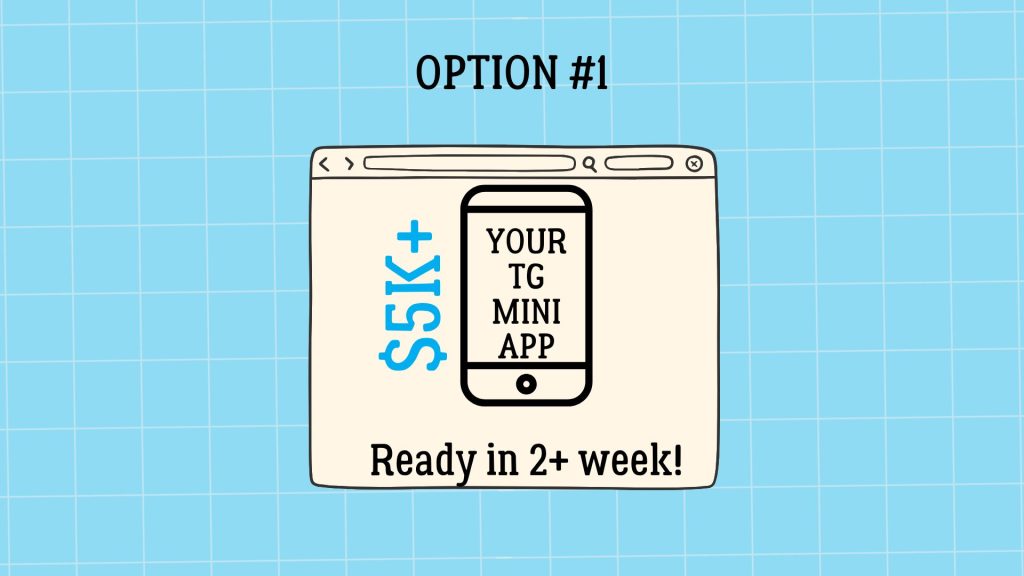
Option 1. Ready-to-launch MiniApp in 2 weeks
We can build a turnkey MiniApp for your business in just 2 weeks. Pricing starts at $5,000.
Your app will be fully prepared to handle traffic and engage users — with analytics, integrations, and core engagement mechanics included.
Option 2. MiniApp with an existing user base
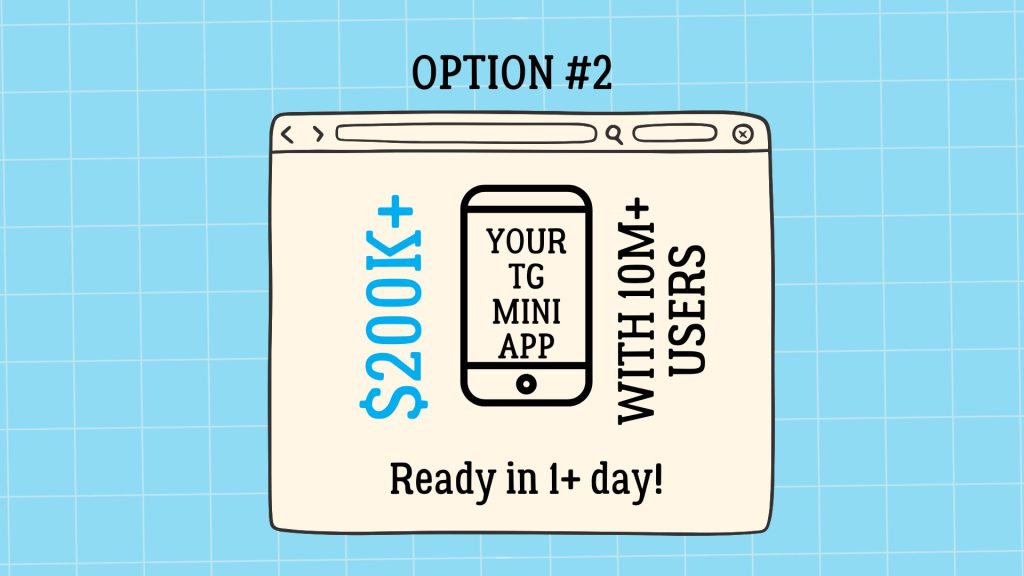
We also provide MiniApps that already come with active audiences.
For example, a MiniApp with 10M+ real users is available starting from $200,000.
This option is ready in just 1 day — giving you instant access to traffic and allowing you to redirect users directly into your business.
💡 Both options let you launch fast with minimized risk. Choose the format that fits your goals – and start working with real users right away.
Need a Telegram MiniApp?
We build everything from quick out-of-the-box solutions (ready in 2+ weeks) to large-scale projects like TripleA News.